

Here’s an inconvenient truth about EAC procurement: most buyers are overpaying for environmental attribute certificates.
Every seller and intermediary will charge as much as they can. But these markets are demand constrained right now, and when the pool of buyers are overpaying because of information asymmetry, it creates an inefficient market. Ultimately, this is a huge part of what’s keeping more capital out of environmental markets.
The issue is the price a buyer pays is not always the price a supplier receives. And the price the supplier receives is not always money that gets reinvested in scale at the project level. In a fragmented, opaque market, some of that gap comes from intermediary markups that buyers can’t see and suppliers can’t easily challenge. Sometimes the gap is substantial.
That creates waste. Wasteful markets don’t scale.
Right now, suppliers are operating on weak information about what buyers are actually willing to pay. Intermediaries hoard information to protect commercial relationships and preserve their markup.
We know this because we have more data than either side of the market on its own: price, availability, quality, as well as buyer preference and ability to pay. When our customers and prospects share what they’ve been quoted, we can compare it to what real suppliers are indicating, and it rarely reflects well on the middlemen.
An intermediary earns its spread by creating value for the buyer, the supplier, or both. Or it earns it through sheer inertia. The value Patch provides comes from making the market more transparent and competitive.
An open, competitive procurement process helps buyers understand what they’re buying and why it costs what it costs. It gives suppliers a clearer view of qualified demand and creates more opportunities to compete for volume. And it gives the market better information about which price differences reflect real differences in quality, scarcity, delivery risk, or timing.
It’s time for CSOs to level up their process and governance
Chief Sustainability Officers have gone through several evolutions, and the latest one is portfolio manager. At the enterprise level, corporate sustainability is becoming an exercise in spreading both impact and risk across all available avenues from direct decarbonization to market-based mechanisms of every type and class. They may have started with RECs or carbon credits, but mandates are getting broader along with budgets, if not always headcounts.
That means making decisions across project types, methodologies, vintages, geographies, suppliers, and pricing structures. No buyers in the market have perfect knowledge across all attributes. And often the information asymmetry is severe.
Most buyers struggle to know:
- What’s the available supply market-wide
- How the price compares with relevant alternatives
- Whether the project meets their quality and climate goals
- Which information is well supported
- Which risks require additional diligence
- Whether stronger or better-fitting alternatives are available
- How the purchase fits into their broader portfolio
That creates massive problems inside the organization. Enterprises can be siloed or limited internally. Sustainability may care about quality and climate impact. Procurement may care about price and terms. Finance may care about budget and risk. Legal and communications may care about the claims the purchase can support.
A transparent procurement process with rigorous governance at every stage gives each stakeholder a shared record of the decision. It makes the price easier to explain, the tradeoffs easier to evaluate, and the final purchase easier to defend.
An RFP is a conversation with the market
Almost no one buys EACs off a single quote anymore. Most procurement teams know to run an RFP. But for too many buyers, the conversation stops once they receive submissions. That’s a problem, because an RFP isn’t like browsing prices on Amazon. It can materially affect the market. It can even drive prices up.
Much of the voluntary carbon market, for example, moves through intermediaries reselling the same limited pool of projects. Send an RFI to five brokers and some of them may go to the same developer for the same tonnes. From the developer's side, that looks like a surge in demand — and it gets priced like one. A well-meaning RFP can end up raising the price it was supposed to test.
Timing does the same thing on a bigger scale. Nearly half of annual transacted volume gets contracted in Q4, when most buyers run their annual process at once, and our data shows Q4 pricing has averaged a 13% premium over the rest of the year.
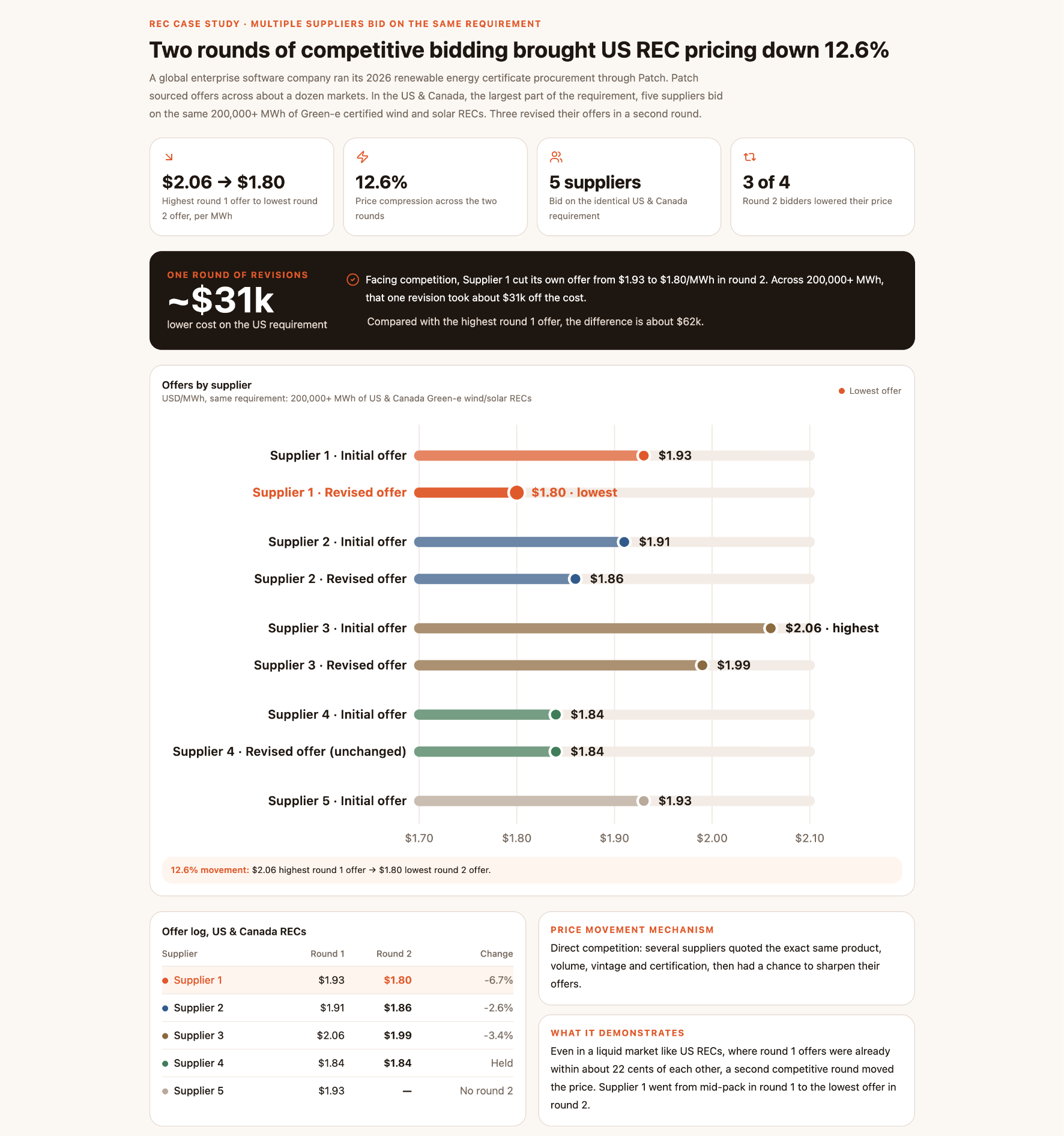
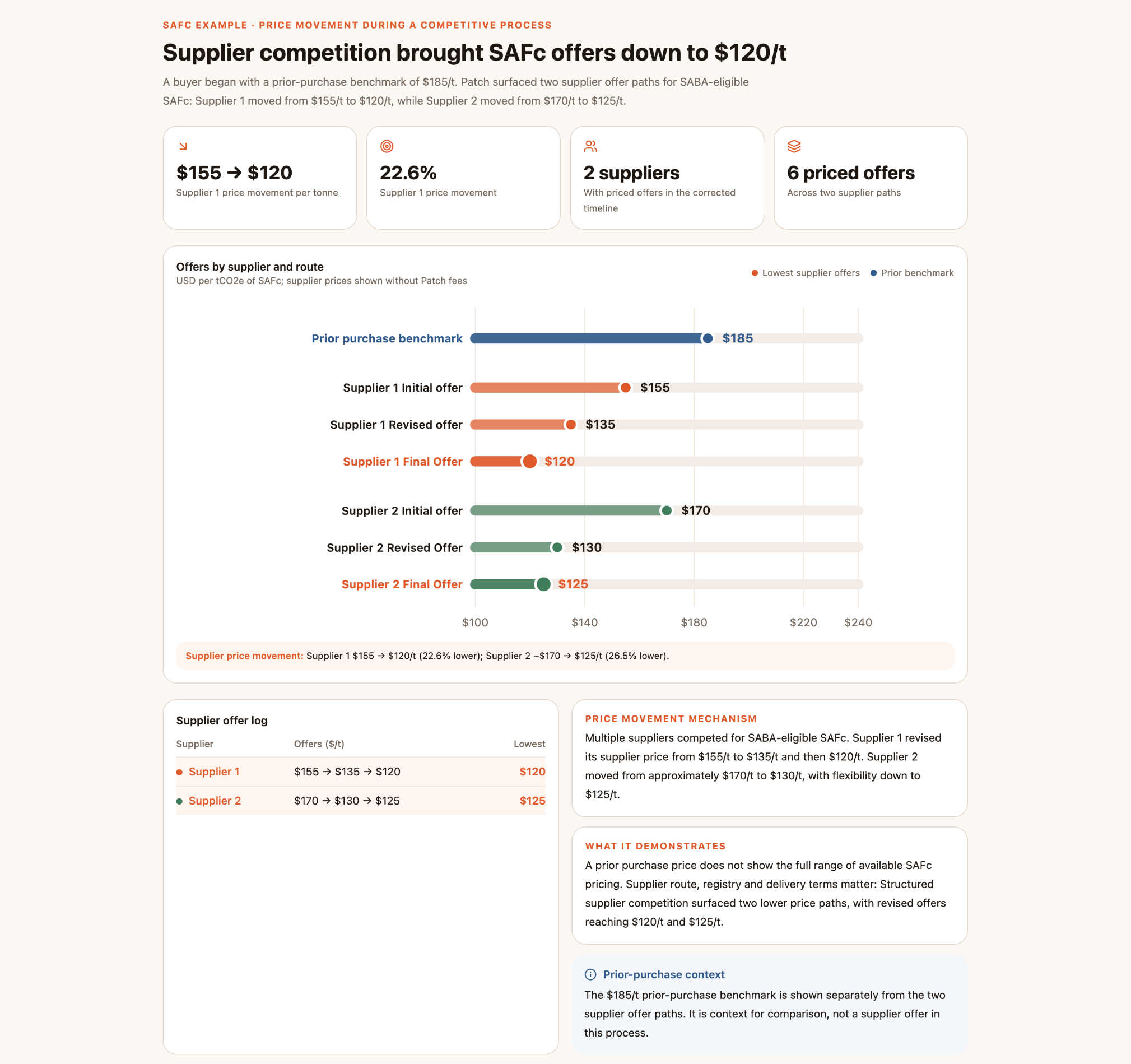
Competition lowers prices under specific conditions: distinct suppliers bidding on the same or comparable inventory, room for them to revise their offers, and demand that reaches each real holder of supply once instead of multiple times.
But it only works when the conversation is ongoing, and it’s happening out in the open.
Competition creates price visibility at two levels
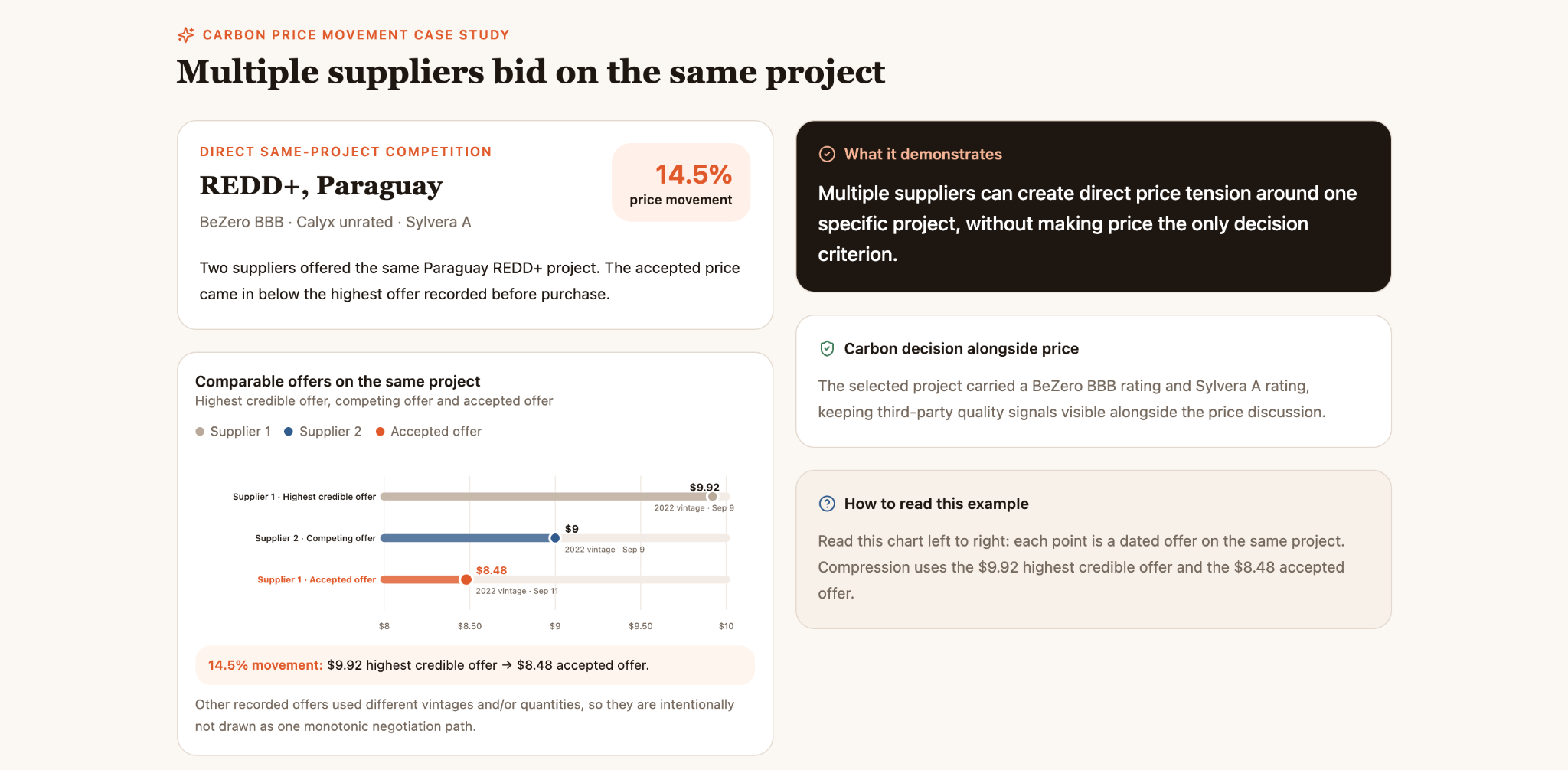
Competition can happen when suppliers offer the same project, or when suppliers offer similar projects in response to the same buyer demand.
Same-project competition helps buyers understand how different suppliers price access to identical underlying supply. Competition across similar projects gives buyers a broader view of the available market, including differences in quality, price, availability, and delivery terms.
1. Competition on the same project
When multiple suppliers offer the same project, a buyer can compare how each supplier prices access to the same underlying supply. In Patch’s analyzed offer data, when multiple suppliers offered the same project, the price moved lower in 66% of cases.
For comparison, when the same project received multiple offers from only one supplier, the price moved lower in 40% of cases.
The 40% figure is an important baseline. Price can still move when only one supplier is involved, through repricing, changes in volume, vintage, timing, delivery terms, inventory, or negotiation. The comparison suggests that multiple suppliers can create additional price tension around the same project, while also giving the buyer a stronger reference point.
These figures describe the frequency of downward price movement, not the size of the reduction (more on that in a second).
2. Competition across similar projects
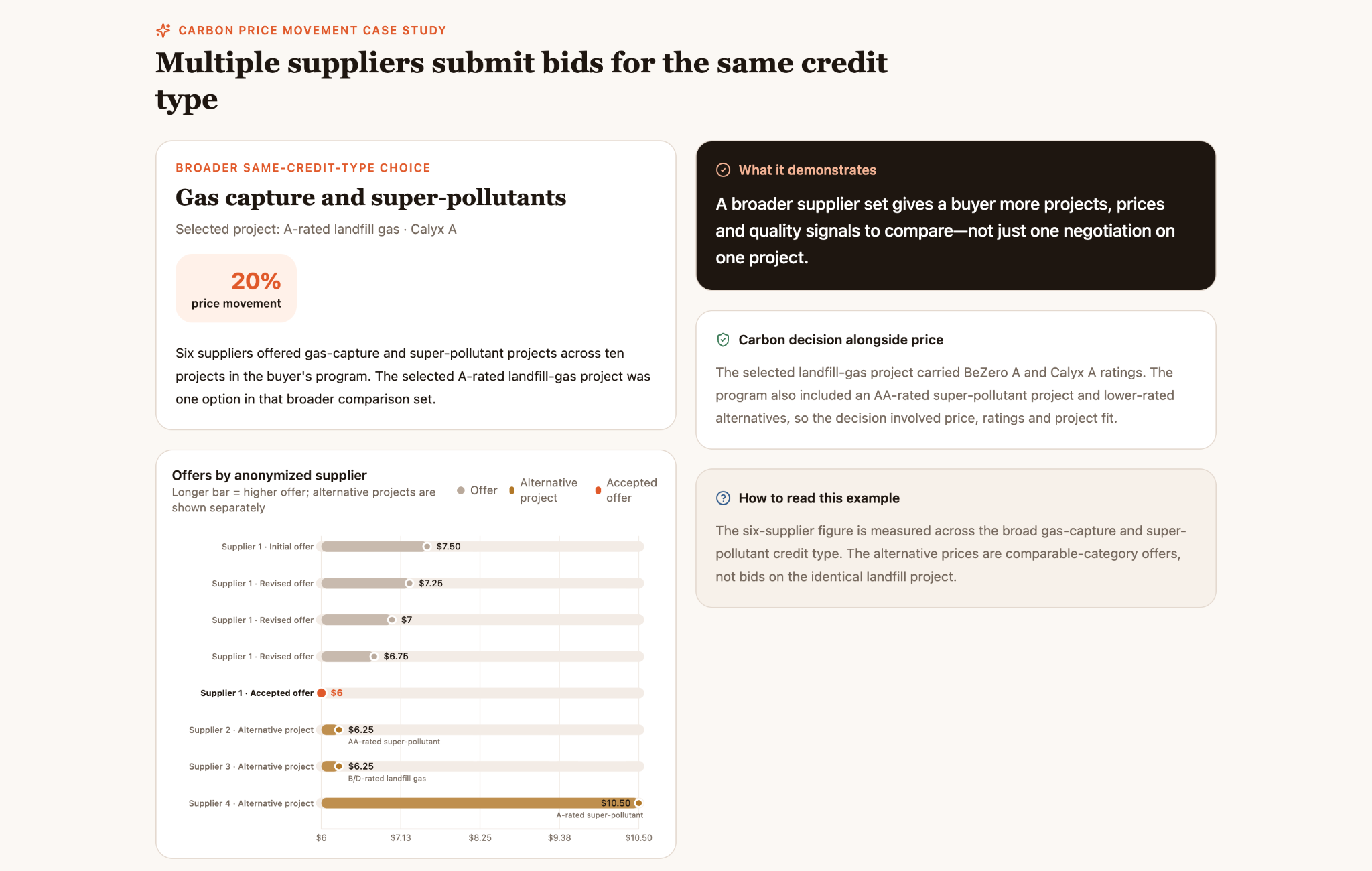
This is a broader form of competition. The suppliers may be offering different projects, but the projects are responding to the same buyer demand, such as a need for a particular technology, methodology, geography, vintage, quality level, or delivery timeline.
When multiple suppliers offer the same type of credit, buyers can compare a wider set of projects and understand the tradeoffs between price, quality, availability, and fit. In Patch’s analyzed offer data, the price moved lower in 46% of cases when two or more suppliers offered the same credit type.
When only one supplier offered that credit type, the price moved lower in 31% of cases.
So competition doesn’t always produce a lower price, but it does give buyers more information about the range of available outcomes. That information can affect the price, the terms, the project selected, or the buyer’s decision to proceed.
Price compression
The comparisons above measure how often price moved lower in different procurement conditions. To measure the size of the reduction or price compression, Patch compares the highest credible offer in a procurement process with the price in the proposal the buyer ultimately accepts:
Price compression = (highest credible offer - accepted proposal price) / highest credible offer
Across Patch’s dataset of completed procurements:
- The accepted price was lower than the highest credible offer in 42% of cases.
- When the price moved down, the median reduction was 8.3%.
- Approximately one quarter of procurements achieved reductions of about 16% or more.
A process can work even when the accepted price stays the same. Competition may confirm that the buyer is already close to the available market range. It may also show that the buyer’s requirements are limiting the number of viable alternatives.
The value lies in knowing which situation you are in.
Here are three scenarios where situational awareness resulted in real price compression:
Competition should clarify supplier value, too
Suppliers have a fair objection to the idea that every buyer should simply push prices down.
High-integrity projects are expensive to develop, verify, finance, and operate. Developers need credible revenue signals before they can invest in additional capacity. A lower price per tonne is only useful to a supplier if it comes with enough volume, predictability, or operating efficiency to support the business.
That’s why the objective should be a price that reflects the economics of the credit and the transaction. Quality, scarcity, delivery confidence, timing, and project risk can all justify a premium. Simply being the incumbent broker for a buyer does not.
More transparency can help suppliers, too. It can give them:
- A clearer view of qualified demand
- More opportunities to compete for volume
- Better evidence for project pricing
- Lower customer acquisition and sales costs
- More predictable demand for future capacity
- A way to distinguish real quality premiums from buyer-specific markups
A supplier may accept a lower price per tonne if the transaction produces more volume, faster contracting, lower distribution costs, or stronger revenue visibility.
The market benefits when buyers can separate legitimate supplier economics from avoidable intermediary margin.
How Patch makes price discovery practical
Our entire AI-native services strategy aims to drive huge efficiencies across every phase of procurement. This has a deflationary effect on prices for our clients. The promise to suppliers is that those efficiencies will lower the cost to entry for more buyers and more capital, which will create the predictable, increasing demand signals that will ultimately drive the market to scale. AI is a fundamentally deflationary technology, and it’s the connective layer across the Patch system.
At a high-level, this is how we run procurement programs for buyers:
- Define the buyer’s requirements. Patch works with the buyer to translate its climate goals and procurement criteria into requirements such as project type, methodology, geography, vintage, volume, delivery timing, ratings, and budget.
- Identify relevant projects and suppliers. Patch searches its project and supplier data to identify potential matches. The buyer can review the options and create a shortlist based on its priorities.
- Bring the shortlist to market. Once the buyer has identified the projects or types of projects it is interested in, Patch reaches out to relevant suppliers and invites them to submit offers.
- Collect and compare offers. Patch organizes the offers in a structured process so the buyer can compare price, volume, vintage, delivery terms, availability, project information, and other relevant criteria.
- Create competitive price discovery. Suppliers may compete for the same project or offer comparable projects for the same buyer demand. They may revise their offers, and Patch may negotiate or seek improved terms where appropriate. Price does not always move, but the process makes the available market outcomes more visible.
- Diligence on the finalists. Expert-led diligence reviews ensure every option meets the same rigorous standard and the buyer has confidence in the projects before committing capital.
- Select and execute the procurement. The buyer selects the projects and suppliers that best fit its requirements. Patch then supports the purchase and subsequent retirement, reporting, and portfolio management.
For the analyses in this article, we reviewed a representative selection of recently logged records across nearly 10,000 offers, hundreds of unique suppliers, over half a million registry retirements connected to our project data, and well over 5.4 million tonnes purchased through Patch buyer programs.
A competitive, transparent procurement process gives buyers more choice, clearer visibility into prices and terms, and greater confidence in the project, supplier, and price they select. It also makes price compression measurable, so buyers can see what competition changed and why. For suppliers, it creates a more organized way to compete for qualified demand.
The principle underneath market-based environmental mechanisms is letting market dynamics drive climate impact to scale. That will only happen when market actors on all sides compete to drive efficiency and create value.