
The push and pull of supply and demand is the heartbeat of a market. But in a carbon market that's relatively nascent and defined by ever-evolving standards, that heartbeat can be extremely irregular — and therefore extremely hard to forecast.
That means many corporate buyers with long-term carbon credit procurement goals find themselves struggling to understand whether the strategy they set today will be viable tomorrow.
Right now, the market may have plenty of credits in aggregate. But a buyer with strict requirements for quality, methodology, ratings, vintage, timing, and price may struggle to fill their program. That's why a market-wide supply forecast isn't useful to that buyer, and also why it's hard to get to one that is.
The 2024/25 IETA and PwC GHG Market Sentiment Survey shows why the broader debate remains unsettled. 67 percent of respondents who expressed an opinion expected CORSIA to be undersupplied by 2027. In the voluntary carbon market, 76% expected supply to meet demand from companies pursuing net-zero targets by 2030.
We're talking about different markets and time horizons, but it illustrates the gap. If the market projects to be oversupplied but the credits you need aren't available when you need them and at your price point, you might not see that gap coming until it's too late.
Let's say you're targeting CCP-labeled credits in your strategy as an integrity signal. Will there be enough affordable supply of those credits to meet your targets in 2030? That's the critical question.
What does a CCP label tell a buyer?
A CCP label is a quality signal. The Integrity Council for the Voluntary Carbon Market describes the Core Carbon Principles as a benchmark for identifying carbon credits with real, verifiable climate impact. Credits can receive the label when they come from an eligible program and use an approved methodology that meets the ICVCM’s assessment criteria.
The label says something important about a credit’s quality framework. It does not provide a five-year issuance schedule, guarantee project performance, or establish that the credit will meet every other requirement in a buyer’s procurement policy.
The CCP universe is also still changing. The ICVCM continues to assess programs and methodologies, and its decisions can include conditions or remedial actions.
In its May 2026 assessment decisions, the ICVCM said that approximately 6.44 million credits had been issued under approved versions of the ACM0008 methodology. It also said that few were expected to qualify for the CCP label because of the conditions attached to the approval.
That's yet another challenge for projecting supply availability. How many projects will ICVCM label? How many tonnes will those projects issue? How will the rates change in the coming years?
Why does today’s supply count tell us so little about tomorrow?
A current count tells a buyer what exists under today’s rules and data. It says less about what will be issued, approved, rated, and purchased several years from now.
The difference comes from the details. A project may be expected to issue a certain volume, then take longer to reach the relevant approval stage or issue less than its original documentation projected. A methodology may pass review with conditions that limit which credits qualify. A project may remain eligible for the CCP label while falling below a buyer’s rating threshold. Prices may also rise beyond what the buyer is prepared to pay.
Each of these changes narrows the group of credits a buyer can use. They also affect different parts of the procurement plan. Timing matters if the buyer needs credits in a particular year. Issuance matters if the program depends on a certain volume. Ratings and price matter when the buyer decides which of those credits are actually acceptable.
A project count cannot show those differences on its own.
What does a future CCP-labeled supply forecast need to track?
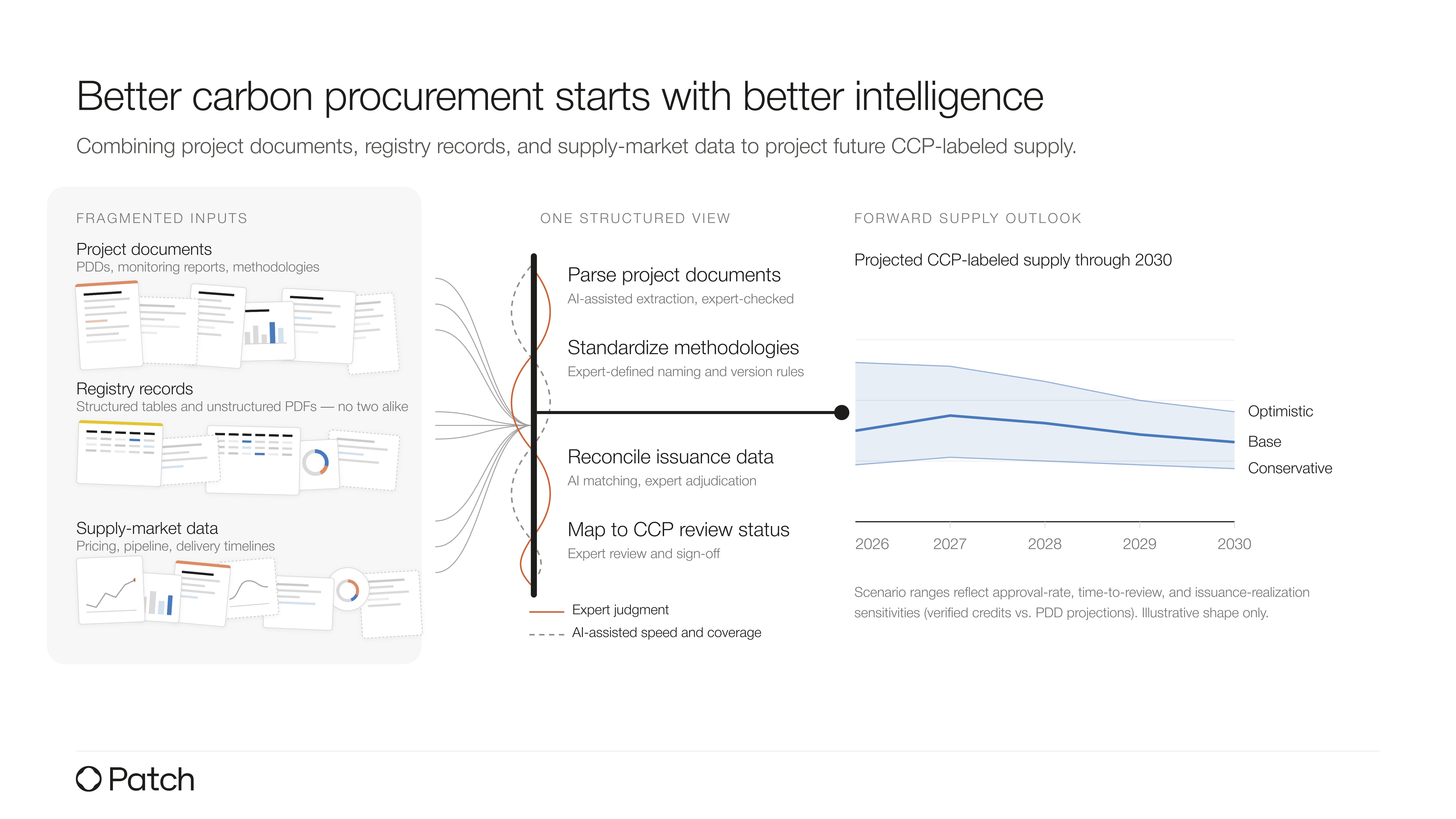
A forecast of future CCP-labeled supply needs to connect project and methodology information that usually sits in separate places. The relevant evidence may include registry records, methodology versions, Project Design Documents, ICVCM assessment status, expected issuance, and historical issuance performance.
The hardest part is not finding each item individually — though that's not always easy. What's really difficult is matching each item to the right projects and methodologies, deciding which sources are authoritative, and identifying where the evidence is incomplete or inconsistent.
The forecast then has to account for the steps between a project appearing in the pipeline and credits becoming available with the CCP label. That includes the time required for methodology decisions, the likelihood of approval by category, and the amount of expected issuance that projects have historically delivered.
Ratings, pricing, and availability add another layer. They do not necessarily determine whether a credit can receive the CCP label, but they may determine whether a buyer can use it.
That is how a market can show substantial potential future CCP-labeled supply while a particular procurement program still faces a shortage.
How can AI help with this analysis?
AI can make a document-heavy supply analysis practical at a useful scale. It can extract information from long project documents, standardize inconsistent terminology, connect project and methodology records, flag missing information, and make it faster to rerun the analysis when assumptions change.
The analytical process still needs to be designed by people who understand the market and the decision the buyer is trying to make. They decide which sources matter, how to handle ambiguous information, which assumptions are reasonable, and how much confidence to place in the result.
A general-purpose model may be able to summarize a document, though the length and variance of many PDDs can cause LLMs huge problems. But even then, a supply forecast requires more than summaries. It requires a consistent way to interpret evidence across projects, methodologies, registries, approval decisions, and issuance records
Purpose-built agentic software makes the process easier to repeat, but only experts can develop and audit the process itself.
To learn more about how we design and execute market projections like this, set up a meeting with our Embedded Climate Strategy team today.
What should the forecast tell a buyer?
A useful forecast should show how much future CCP-labeled supply could be available under different assumptions, and which assumptions have the greatest effect on the result.
For example, it may show that approval timing creates a short-term gap, issuance performance is the main source of uncertainty, or layering a ratings or price filter reduces the usable supply too far below the needed availability threshold.
That information gives a buyer something to work with. They can see which parts of the procurement plan are most exposed, what they should monitor, and where flexibility may be available.
A single number without those assumptions is difficult to act on. A range without an explanation is not much better. The value of the analysis lies in helping buyers interpret the range, as well as understand how it impacts procurement criteria, process, and timeline.
The important question is buyer-specific
The market will continue to produce broad estimates of future carbon credit supply. Those estimates are useful for understanding the direction of travel, but they cannot tell every buyer whether their own criteria will remain workable.
That requires a buyer-level analysis of future supply that meets their requirements — including CCP-eligibility and labelled-status. It also requires understanding the approval and issuance steps that determine whether potential supply becomes real supply. Lastly, it requires a clear view of the ratings, pricing, geography, etc. — any and all conditions that determine whether the buyer can ultimately transact.
For companies building serious carbon procurement programs, understanding that difference early creates room to make deliberate decisions later.
Frequently asked questions
Does a CCP label guarantee future carbon credit availability?
No. A CCP label indicates that a credit comes from an eligible program and approved methodology that met the ICVCM’s requirements. It does not guarantee future issuance volume, approval timing, project performance, ratings, pricing, or availability to a particular buyer.
What causes carbon credit issuance to fall short of original estimates?
Issuance can fall short when a project is delayed, its operating assumptions change, monitoring or verification takes longer than expected, or the original projection proves too optimistic. Buyers should compare forward issuance estimates with historical issuance performance and review the assumptions behind the forecast.
Should buyers loosen their credit criteria if supply looks constrained?
Not automatically. Buyers should first identify which criteria are essential to their climate and risk objectives, then test how each requirement affects future supply, price, and timing. That may reveal places where flexibility is possible without compromising the principles the procurement program was designed to protect.